Monday, May 20, 2013

Prof Adri Vermeer, the Attendance Headache, Pat Richards hits the Streets, Don's News and RI News that affects us.

Last week we had a really fascinating talk by Prof Adri Vermeer about his involvement with children with disabilities in rural South African situations.  After our meeting Hugh Rix took him to Woodside Sanctuary.
Unfortunately we had a poor turn-out.  I seem to be banging on about this but when Tom Wheeler mentioned in the Johannesburg North Club Newsletter last week that he had attended one of our meetings and said that he was astonished that New Dawn had only the same attendance as his own club.  Yet we have more than double their membership!  How embarrassing!

Every week I put down members for various duties and it is a complete waste of effort because seldom are the people there to do them. Some members do apologise for non attendance but it is the minority of absentees.  This is a big problem.  What are we doing wrong?  The weekly meeting is supposed to be the time when we get together on a regular basis.


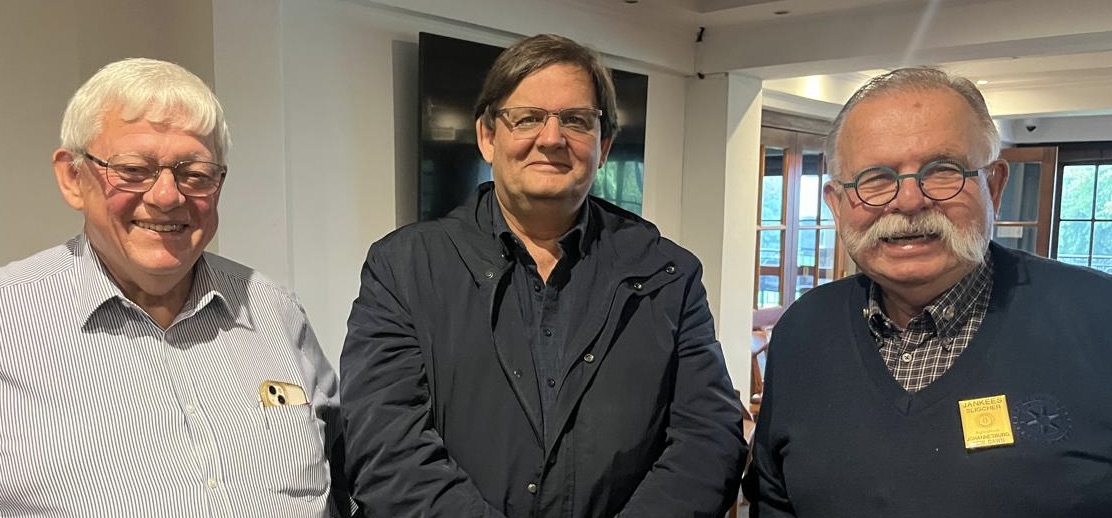
Just to emphasise the attendance problem, this photograph shows everyone, except me, who was present last Wednesday.

This Week
Pat Richards will be talking to us about 'Street Children and Street People'.  This is a talk she recently gave to Parktown Excalibur Inner Wheel and it was well received so I asked her to repeat it to us.

Don & Arthur
Here's an email from Don Lindsay, just lightly edited.....I cut out anything vaguely pornographic.

Hi Peter,

Now that I am installed in Rotary on this side, I thought you and the other members might be interested in some news.

I have been inducted into the Rotary Club of Curitiba Agua Verde which is not only a breakfast club but also meets in an hotel on the next block from our new apartment. I can now wake up 15 minutes before Rotary and still be on time (eat your hearts out Nicci & Amina!). As the working day really only starts here between 9:00am & 9:30am, I can even hang around after meetings for a relaxed chat.

The profile of Rotary here appears to be very similar to that of SA with a lot of smaller clubs and a mix of members drawn from the professional, business, educational and NGO sectors.  It is however much bigger.  There are more than 69 000 Rotarians in Brazil spread across 38 districts and 2 390 clubs.  Our district, 4730, comprises the state of Parana and has more than 1 600 Rotarians. Curitiba alone has 32 clubs. Rotaract & Interact seem to be quite well established as well so Rotary has quite a presence here.

Our club currently has 17 members and membership seems to be on the up with 4 recent additions, including myself.  The club has only ever had one other non-Brazilian member and I have the distinction of being the first gringo! The members are a very friendly and welcoming bunch and I feel very much at home.  

Our projects include a programme to provide hearing assessments in local primary schools and another to provide poor elderly people with access to cataract operations. The club is active in both long and short term youth exchange and supports 2 Rotaract clubs. It also participates in various district level projects and a number of members serve on district committees. We have one ex-DG in the club and another will be the District Governor in 2015/16.

The club, and indeed people I have spoken to at district level are keen to establish links with South African clubs so I will keep my ears open for opportunities for our two clubs to work together.  Of course if you have any ideas you would like me to put to the board on this side, just let me know.  I am sending you a banner and would be most grateful if you could please send me one from New Dawn. It would be nice and nostalgic to see a New Dawn banner on display at our meetings. I can’t believe I never thought to pack one.

On a personal level we are settling in very well.  Curitiba is a delightful city to live in.  It is very compact and has a well-deserved reputation for offering Brazil’s best urban lifestyle.  There are lots of parks and public transport is really super so much so that we have not yet had to buy a car.  It also enjoys an enviably low crime rate. It is however an enormous, and very tiring, challenge to learn to communicate in a new language although the task is greatly facilitated by the patience, friendliness and charm of Brazilians.  Renovations to our apartment should be finished at the end of the month, in time for the arrival of our furniture. We are thrilled with it and can’t wait to move in. I plan to start working on the 3rd June in a business consultancy which will make a nice change from intensive Portuguese classes.  Arthur will continue commuting for the foreseeable future but plans to practice here in the next year or so when I have become established.

Fond regards to everyone and all the best to Joan and her board for a great year.


Abraços,

Don Lindsay
Cel: +55 41 8811 9889

Council approves dues increase, unlimited e-clubs


Council representatives hold up green cards to demonstrate a yes vote on a motion.Monika Lozinska/Rotary International
Representatives from Rotary’s 532 districts met in downtown Chicago 21-26 April, approving a number of measures designed to strengthen Rotary, increase membership, and enhance the organization’s capacity to serve.
The Council on Legislation meets every three years to consider changes to the policies that govern Rotary International and its member clubs. This year’s Council accepted an increase of US$1 per year in per capita dues, removed limits on e-clubs, permitted satellite clubs, and changed the name of the fifth Avenue of Service to “Youth Service.”
The dues increase means Rotary clubs will pay Rotary International annual per capita dues of $54 in 2014-15, $55 in 2015-16, and $56 in 2016-17. Dues for 2013-14 had already been set to $53.
The RI Board of Directors proposed the increase based on afive-year financial forecast that projected that Rotary’s spending would exceed revenues by $9 million in 2018 if there were no increase. The result would be a drop in the General Surplus Fund below the level required by the RI Bylaws.
With the increase, spending is projected to exceed revenue by about $5 million in 2018, according to the forecast, which keeps the surplus fund above the mandated level. Supporters said the increase would be sufficient to keep pace with inflation without necessitating cutbacks in service. Dues are the primary source of funding for Rotary’s operations.
During the week, the 2013 Council considered more than 170 enactments and resolutions proposed by Rotary clubs, districts, or the RI Board.
“It has been a pleasure for me to serve you as chair and work with you this week on the legislation before the 2013 Council on Legislation,” Council Chair John Germ said. “You have come with energy and thoughtfulness, and you have represented your districts well.”
Council Representative William Pollard from Virginia, USA, noted that the representatives were united in a desire to make Rotary a stronger and better organization.
“Rotarians have different viewpoints on various issues and topics, and this is good for Rotary,” he said. “I quickly learned that some items that might not be important to my district might be very important to a district in another country.”
Among other actions during the week, representatives:
  • Allowed districts to have more than two e-clubs. The 2010 Council made e-clubs, which meet electronically, a permanent part of Rotary. Proponents argued removing the limit will bring in new members and will appeal particularly to young professionals, who may be less able to meet in person weekly.
  • Approved satellite clubs, whose members meet at a different time and location from their parent club but are still considered members of the parent club. The measure is intended to make it easier for members to develop the core for a new club.
  • Increased the number of clubs that can take part in pilot projects from 200 to 1,000. The RI Board uses these pilots, which last for up to six years, to test new ideas, methods, and organizational frameworks for clubs. Pilot clubs that participate in these experiments are fully functioning Rotary clubs but are exempt from some requirements of the Standard Rotary Club Constitution.
  • Approved changing the name of Rotary’s Fifth Avenue of Service, currently called “New Generations Service,” to “Youth Service.” The 2010 Council approved this Avenue of Service for youth, which joined the already established Club Service, Vocational Service, Community Service, and International Service. The name “New Generations” was meant to reflect the need to build the next generation of Rotarians, but proponents of the name change argued Wednesday that the word “youth” is more universally understood, both inside and outside Rotary, and clarifies the fact that these programs encourage Rotarians to empower youth.
  • Approved a measure allowing participation in club projects to count toward club attendance requirements. The measure amends the Standard Rotary Club Constitution to require that a member attend or make up at least 50 percent of regular club meetings or engage in club projects for at least 12 hours in each half of the year, or a combination of both.
  • Approved a measure allowing Rotarians outside the United States and Canada to receive an electronic edition of their official regional Rotary magazine, if one is available. Rotarians within the United States and Canada were given the option of receiving a digital version of The Rotarian by the 2010 Council.
  • Approved a measure creating the office of vice governor, who would act as a substitute if the governor became unable to serve. The vice governor would be selected by the district’s nominating committee from among the district’s past governors.
  • Removed the travel reimbursement policy from the RI Bylaws. This will enable the RI Board of Directors to develop a policy that is flexible, able to address emergency travel situations, and able to take advantage of cost-saving opportunities.
  • Defeated two measures affecting Rotaract, Rotary-sponsored service clubs for men and women ages 18 to 30. The Council rejected raising the age limit to 35, arguing that the older members would have little in common with 18-year-olds. They also argued Rotarians should reach out to include Rotaractors who are reaching the age limit in their Rotary clubs. They rejected establishing lower dues for Rotaractors who want to join Rotary, partly because Rotaract membership records have not been collected by RI.
Douglas Vincent, a representative from Ontario, Canada, said he was a little disappointed the Council didn't adopt more changes, but feels the process serves a valuable function.
"Rotarians are the people who drive the organization," Vincent said. "It's important that representatives from the clubs, in a grassroots fashion, direct the policies and rules that govern Rotary International."
With the Council adjourned, an official report of action will be compiled, sent to clubs, and posted online. Clubs have an opportunity to record opposition to any action. If at least 5 percent of the clubs entitled to vote oppose an action, the legislation is suspended and the general secretary conducts a ballot-by-mail. A majority vote would cause the proposal to be rejected. All Council actions otherwise go into effect 1 July.

Monday, May 13, 2013

Back to Normal, Professor Adri Vermeer and More on Polio

Back to Normal!
Thank goodness the laptop has been sorted out and the blog is back to normal.  My apologies to all those on our Rotary non-member list who have not received the blog but I was unable to access the list on my wine-soaked laptop.  A cautionary tale, Dropbox does not save things that only appear on Desktop, only Documents etc.
We also don't have any photographs of last week's meeting so I am having to resort to other things...no, not photographs of me, don't worry!

Mike Vink & Mario Hendricks  Click on this to watch the video.

Business Meeting
At last week's meeting the logistics of the Rotary Family Health Days was spelled out.  I have received no feed back or photos as to how well it went.  Steve Du Plessis was interviewed on 'The Mix' on Radio Veritas on the Friday which was repeated on Sunday.  The other major issue was the development of a three-year plan for the Club and the necessity of identifying a President for 2015/16.

This week


Our speaker is Professor Adri Vermeer, see his Curriculum Vitae below.  I'm not sure what he is going to talk to us about but I am guessing it is his involvement withSizanani Childrens Home in Bronkhorstspruit.

Training:
  • Gymnasium B (Apeldoorn, 1957)
  • School of Military Physical Education (Hooghalen, 1958)
  • Teacher College of Physical Education (Arnhem, 1963)
  • Med Educational Sciences (Free University Amsterdam, 1972)
  • PhD Social Sciences (Free University Amsterdam, 1983); Thesis:Movement and Child Rehabilitation

Jobs:
  • Sport instructor Dutch Army (1958-1959)
  • Teacher of physical education in primary and secondary schools (1963-1973)
  • Lecturer Pedagogics and Didactics of physical education for young children in Teacher College (1966-1971)
  • Assistent professor Faculty of Human Movement Sciences, Department of Educational Sciences, Free University Amsterdam (1973-1985)
  • Ibidem Associate professor (1986-1997)
  • Professor in Human Movement Sciences, Faculty of Social Sciences, Department of Educational Sciences, Utrecht University (1991-1997)
  • Professor in Special Education, Faculty of Social Sciences, Department of Educational Sciences, Utrecht University (from 1997-2001), since 2001 professor-emeritus.
  • Guest Professor European Masters Degree in Adapted Physical Activity, Faculty of Physical Education and Physiotherapy, Katholic University Leuven, Belgium (from 1991)
  • Visiting Professor, Faculty of Physical Education and Health Sciences, University of Jyväskylä, Jyväskylä, Finland (1993)
Johannesburg Zoo Wattle Crane & Ground Hornbill Projects
It was decided at the Business Meeting that we visit these projects on Saturday 22nd June at 10,00am.  Unfortunately I have to attend a Memorial Service that morning but I will send a notice round closer to the event.


In the face of danger


In 1998, thousands of families in Sierra Leone fled their homes as the Revolutionary United Front executed its campaign of terror against civilians.
Despite the chaos, health workers and volunteers carried out National Immunization Days as planned. Polio immunization teams searched for refugees along the nation’s roadways and in the jungles. Risking their lives as heavy artillery resonated nearby, they continued on, determined to provide lifesaving drops of vaccine to every child they could find. Today, Sierra Leone is polio-free.
Because of the sacrifices of those who have participated in the global immunization effort, including hundreds of thousands of Rotarians, polio is on the brink of extinction. Teams have conquered the disease in war-ravaged countries and in regions grappling with political unrest. Only Afghanistan, Nigeria, and Pakistan remain polio-endemic.
But obstacles persist in the final battle for worldwide eradication, and the disease has proved to be a complicated, contentious foe. Misinformation and rumors of conspiracy continue to sweep through some areas, as vicious and nimble as the virus itself. The small drops of vaccine, administered to save children’s lives, become a source of fear, and as suspicion and hostility grow, immunizers can become targets.
The frontline heroes of the world’s war on polio are its health workers and volunteers – the nurses, mothers, fathers, Rotarians, and community leaders who travel door to door, in slums and in isolated villages, to carry out immunization efforts. And with the recent murders of at least 20 health workers in Afghanistan, Nigeria, and Pakistan, as of 2 March, eradicating polio has become an act of courage.
Photographer Jean-Marc Giboux has reported on polio for 16 years, traveling through 15 countries in Asia and Africa, including Sierra Leone, Nigeria, had, Afghanistan, Pakistan, and India, to document the faces behind the campaign.
“The polio workers travel through places of desperation and distress, through every slum, war zone, and refugee camp, with one mission in mind: to reach as many children as possible. No place is off-limits,” Giboux says. “They have a commitment to their cause that you don’t often see. Without them, polio eradication cannot happen. I’m proud to document their legacy.”


.

Tuesday, May 7, 2013

A Rather Shaky Blog, Business, Teeth, Breakfast and Birds. Polio Plus in Cote d'Ivoire.


It has been  disastrous couple of weeks for the blog.as no sooner had I got the ADSL line back than I spilled wine over the laptop keyboard!  By bye laptop!  .......Well, not, actually.  The manufacturers can fit a new motherboard for a reasonable price and they come to my house and do it on Wednesday!  How is that for service!

This week
It's a Business Meeting and an important one....when I say that we usually seem to have a low turn-out.  We have to be looking at the Rotary Year 2015-16 and giving some thought to who will be president then.  Joan Donet will expand on this at the meeting as we need to develop a 3-Year Plan.

Workers Day Breakfast
Many thanks to Joan and Graham Donet for hosting a breakfast at their home last Wednesday.  The weather was kind, the food was good and the company exceptional

Dr Peter Noach  
Thanks Mike Vink for these comments:

Did you know there are good guys and bad guys waging war against each other, and against sugar and fizzy drinks in your mouth? If you were at our lat meeting you'd know, courtesy of Dr Peter Noach, who told us all he knows about dental care in 20 minutes.
     Judging by the many questions asked after his talk, quite a few members would have phoned their dentists after the meeting to set up an appointment!
     The meeting was well attended and apart from Dr Noach, whose father-in-law, by the way, was president of the Rotary Club of Ermelo in the sixties, we also welcomed Samantha Donet as a guest. Apparently she's thinking of single-handedly lowering the average age of the club by five or more years!
There were also a few minutes in the crammed schedule for Prisca Lete to give feedback on her visit to Lausanne to present her research into a rebranding of Sun City.

The Wattle Crane & Ground Horn bill Projects
Gill Nomis from the Johannesburg Zoo introduced Lara Jordan, Curator, Birds who talked about the two projects and showed us some very tiny pictures....Apple doesn't plug into the projector.  Lara emphasised the importance of this conservation project and invited us to visit the zoo and see what was going on.
I will discuss this with the club at the Business Meeting.  Here we do have some pictures!


Rotarians take part in Immunization Days in Côte d’lvoire


Rotarians in Côte d’lvoire took part in National Immunization Days (NIDs) beginning 26 April. They joined thousands of health workers and volunteers in mobilizing public support, ensuring the safe delivery of the oral polio vaccine, and administering the life-saving drops to more than 3 million children. The nation’s last case of polio occurred in July 2011. The NIDs also provided vitamin A supplements and de-worming tablets to children to expand public health benefits, which is another objective of the new polio endgame strategic plan.


Monday, April 15, 2013

The Red Cross, Birds and Boxing

I wasn't at the meeting last week.  Many thanks to Mike Vink for the following:


Gerry Elsdon, better known as the TV personality Gerry Rantseli, was our speaker last week and told the club a bit more about herself and her work as secretary-general of the SA Red Cross Society. She also pledged the society’s help with first aid at the coming Family Health Day project. 
She made up for being late for the meeting (she got stuck in the traffic) by staying after the meeting to discuss logistics with Steve, Amina and Michelle Thulkanam, who has now committed to membership of the club.
 Speaking of the health days, about a dozen club members have given their names to Steve du Plessis for the duty roster. That’s good going, but more people need to sign up, as there must be at least three to four Rotarian on duty every day from 9 am to 4 pm on Thursday, Friday and Saturday 9-11 May. The two addresses are both in Soweto: 3141 Letaba Str. in Jabavu, and 735 Modebane Str in Meadowlands. Both are in a safe and pleasant environment, according to Steve, so please do put your hand up for either a morning or afternoon shift on any of the three days. Contact Steve on 0828934211, or steve@ats-pty.ltd.com to volunteer.

Mini Mohale wrote thanking the club for sponsoring her studies at the HTA School for Culinary Arts last year. The funds were raised at Alex Gano’s Thanksgiving Dinner in 2011, which she attended. Mini did well in her studies, averaging about 70%.


This Week
Gill Nomis and Elaine Reeve from the Johannesburg Zoo will talk to us about the Hornbill & Wattled Crane Projects that Don Lindsay was keen on us supporting.

The Wattle Crane Recovery Programme
The Wattled Crane is one of five Critically Endangered birds in South Africa and is the most threatened crane species on the African continent. The Wattled Crane Recovery Programme (WCRP) aims to prevent the local extinction of the Wattled Crane in South Africa by breeding Wattled Cranes in captivity and releasing their offspring into existing wild flocks. 


The WCRP rescues Wattled Crane eggs that would normally be abandoned in the wild and the resultant chicks are either incorporated into an existing ex situ breeding flock or released back into the wild flock. Wild Wattled Cranes occasionally lay two eggs but will only raise one chick, abandoning the second egg once the first egg has hatched. Natal Wildlife grants an annual permit for the collection of Wattled Crane second eggs as this has no detrimental effect on the wild population. The eggs are harvested by experienced fieldworkers and the resultant chicks costume-reared to prevent human imprinting. Offspring of the ex situ breeding flock will be used to supplement the in situ population.

In order for captive-reared Wattled Cranes to survive in the wild, they must be reared in such a way that they develop sufficient survival skills, such as appropriate feeding behavioural and predator aversion tactics. For the past thirty-three years, conservationists in North America have been successful in recovering endangered crane populations through the release of human-reared cranes into existing wild crane populations by utilising a technique called 'costume-rearing' or 'puppet-rearing'. During the rearing process, human caretakers dress in crane costumes and mimic the behaviours of adult cranes in an effort to teach young cranes survival skills. Feasibility trials were conducted to assess the potential for utilising this technique to increase South Africa's Wattled Crane population, during which a total of thirteen Wattled Crane chicks were reared by humans wearing crane costumes and utilising a crane puppet. The initial trials were successful and once the costume-reared chicks reached fledging age, they were released into existing wild flocks and were successfully integrated into the wild population. 

Mabula Ground Hornbill Project


At present Southern Ground Hornbills are considered 'vulnerable' but their numbers are still declining.
A detailed analysis of data collected by the Project, show Southern Ground Hornbills in South Africa to be 'Endangered' and probably critically Endangered' under IUCN Criteria. 

There are probably only 1500 birds in South Africa, 
half of which are in the protected areas of the Kruger National Park. Groups consist of 29 birds, of which there is only 1 breeding female. From which an average of only 1 chick is raised to adulthood every 9 years.

Over the past 50 years Ground Hornbills have lost over 70% of their natural habitat :

The Mabula Ground Hornbill Research and Conservation Project are addressing these issues by harvesting and hand-rearing of second hatched chicks which die of starvation in the nests, re-introduction and augmentation of non-viable groups in the wild.

The Johannesburg Zoo also assists the project by providing free veterinary car to Ground Hornbills and we have recently taken over hand raising chicks from second egg collections.  http://www.mabulagroundhornbillconservationproject.org.za/

This is an amazing story!


Manny Pacquiao packs a punch


Manny Pacquio makes the This Close gesture. Pacquiao is a brilliant boxer, a Philippine congressman, and the president of his Rotary club.
Manny Pacquiao grew up poor on the island of Mindanao in the Philippines. How poor? He slept in a cardboard box. He begged for pesos. His friends still talk about the day he brought a stray dog home to his family’s shack. The boy cried when the dog wound up in a stewpot.
Young Pacquiao got into fights but not into crime; unlike many fighters, he was never a thug. Sometimes he hid in churches and prayed for guidance. “I wanted a mission in life. A calling,” he says.
Today Pacquiao (PACK-ee-ow) is one of the richest, most popular athletes on earth. According to the 2012 Forbes list of the world’s highest-paid athletes, Pacquiao earned US$62 million in 12 months – second to fellow boxer Floyd Mayweather, ahead of Tiger Woods and LeBron James.
Nobody else in boxing history has matched his versatility. With a record 10 world titles in eight weight classes, Pacquiao has won championship belts in divisions from flyweight (108-112 pounds) up to super welterweight (147-154). His rise began in 1995, when the scrawny kid turned pro at age 16. “I was just a little guy,” he recalls. The young Pacquiao stood at 4’11” and weighed 98 pounds. The story goes that he was so far under the weight limit that he put steel ball bearings in the pockets of his trunks at the weigh-in. Of course, he won.
Since then, his 60 fights have made “Pac-Man” more than a hero to his fellow Filipinos. More like a superhero. His superhuman training routine might melt a weaker man. After a 10-mile mountain run, all of it uphill, he spars 30 to 40 rounds, his punches whistling through the air. Then he hammers the heavy and speed bags for 10 minutes, followed by 10 minutes of skipping rope, 1,000 sit-ups, and his personal abs builder: letting a friend whap his stomach with a bamboo stick. Then he sits down to one of six daily meals – chicken, rice, beans, eggs, and a protein smoothie – before a couple of hours of full-court basketball.
“A man on a mission? That’s him all over,” says Freddie Roach, Pacquiao’s grizzled trainer. “He’s got killer instinct, but there’s something else going on with Pacquiao – something like a higher purpose.”
Two years ago, in a title bout at Cowboys Stadium, the 5’7” champ rained 474 punches on challenger Antonio Margarito. He broke Margarito’s right orbital bone. “Finish him off!” Roach yelled from Pacquiao’s corner.
Instead, the champ backed up. “Boxing isn’t killing,” he said. “I beat him up enough.” Margarito lived to fight another day.
Pacquiao has leveraged his fame into political punch, running for a seat in the Philippine House of Representatives. He lost the first election, a setback that led to three years of grassroots prep for the next. The second time around, his opponent had no shot against a national icon whose face was already on a Philippine postage stamp. Pacquiao won by a landslide and took office in June 2010. As a junior legislator, he was expected to spend his time shaking hands and waving to crowds, leaving the grind of day-to-day politics to his elders. “Except he didn’t do that,” Roach says. “He started acting like a real congressman.”
The rookie lawmaker secured $4.5 million to build a hospital in his native Sarangani Province. He backed a bill to fight human trafficking. And in 2011, Congressman Pacquiao went to Washington, D.C., to urge Senate Majority Leader Harry Reid, a former Golden Gloves boxer, and Reid’s colleagues to pass a trade bill that could create thousands of jobs for Philippine garment workers.
“My people do not want handouts. They want jobs,” Pacquiao tells me, “and it’s my job to help them.” He speaks with a steady intensity that leaves no doubt that he means what he says. As those around him attest, the fighting congressman takes his second career as seriously as his first.
“I told him to wait. ‘Boxing first,’ I said, ‘then politics,’” recalls Chavit Singson, governor of Ilocos Sur Province, who serves as one of Pacquiao’s advisers. “But Manny, he follows his heart.” Singson, a colorful politico whose Manila mansion is guarded by a tiger, was amazed to see his friend hand money to needy citizens. “Cash right out of his pocket.” Pacquiao bought one stranded constituent a car. Another time he fought homelessness as directly as possible: He bought a homeless man a house. “He is the people’s hero,” Singson says.
In Washington, Pacquiao met a 6-foot-1 hero of his own: “President Obama, he’s tall,” he marveled after they discussed the trade bill, their shared love of NBA basketball, and the champ’s upcoming bouts. Obama closed their summit by handing over shopping bags full of presidential-seal M&Ms for Pacquiao’s four children and a presidential-seal wristwatch that now adorns the congressman’s office in Manila.
At 34, Pacquiao is nearing the end of his boxing prime. Many fans have dreamed of the day he (finally!) squares off against unbeaten Mayweather, his longtime rival for the unofficial title of World’s Best Boxer. Mayweather, a cocky American who likes to show off his fleet of luxury cars and diamond-studded platinum iPod, has spent five years thrashing lesser contenders, ducking his Manny-fist destiny. Their showdown promises to be the most important fight in decades, the richest in history, a bout that might reverse the sport’s long slide into second-tier status. “It would be a great fight,” Pacquiao says. “Maybe the greatest.”
Meanwhile he continues to train, zipping around his homeland in a bulletproof Escalade, and still finds time to lead the Rotary Club of Manila 101. “After winning my first few world titles, I was asked to speak there,” he says. “I guess you could say I liked being a Rotary guest so much, I decided to join. The club appeals to my core beliefs in service to others. It nurtures my soul.” He has boosted its efforts to improve and even save lives. “We’re supplying much-needed medicine, food, and clothes to those who need help,” he said in the wake of a recent typhoon.
Bob Arum, the legendary promoter of fights including the epic Muhammad Ali-Joe Frazier “Thrilla in Manila” in 1975, sees Pacquiao as more than a moneymaker. Comparing his top client to Gandhi and Nelson Mandela, Arum says, “We’re seeing an early stage of a world leader’s life. Manny is going to be president of the Philippines.”
Yet he entered 2013 at a career crossroads. Back in June, Pacquiao lost a controversial judges’ decision to Timothy Bradley, though most experts thought Pac-Man had won. His career record still stood at 54-4-2. Then, in December, he fought Juan Manuel Márquez at the MGM Grand arena. Pacquiao was leading on the judges’ cards when Márquez stunned the boxing world, knocking him out with a sixth-round haymaker. As the fighting congressman lay flat on the canvas, a Mayweather showdown looked distant. There were whispers that Pacquiao had lost his edge.
He swore it wasn’t true. He’d come back stronger than ever, he said.
And his political plans?
“My mind is on my next fight,” he tells me, ducking the question like an expert politician.
“What about after that? Do you want to be your country’s president?”
He smiles. It is the one smile I get out of Mr. Sincerity, a crinkle of the lip that says me to know, you to find out. He’s too smart to announce any career plans before this year plays out – and too young to run for president until 2022. Still, that smile suggests that we’ll be hearing from Congressman Pacquiao even if he never knocks out Floyd “Money” Mayweather.
“Boxing is my passion,” he says, “but public service is my calling.”