Sunday, 28 August 2011

Mantra, Richard Cock & 3 New Members


It's the Fifth Wednesday so there will be no Breakfast Meeting, instead we will be meeting/eating at Mantra, 17 4th  Ave Parktown North, 19,00 for 19,30.

These evening are always fun and open to all so please invite partners, potential members, anyone and please let Allan Beuthin know that you are coming.

Last week our speaker was Richard Cock.  He looks as if we are all singing here!  President Jankees Sligcher is organising for us to go to Starlight Classics at The Country Club Johannesburg on Saturday 10th September.  If you are not a member of the Country Club you have to book through Caroline at Richard Cock's office 011 447 9264

At the meeting we welcomed three new members, Ann Bourdin, Angela Neil and Niel Chen.  Congratulations all of you and welcome to the Club!


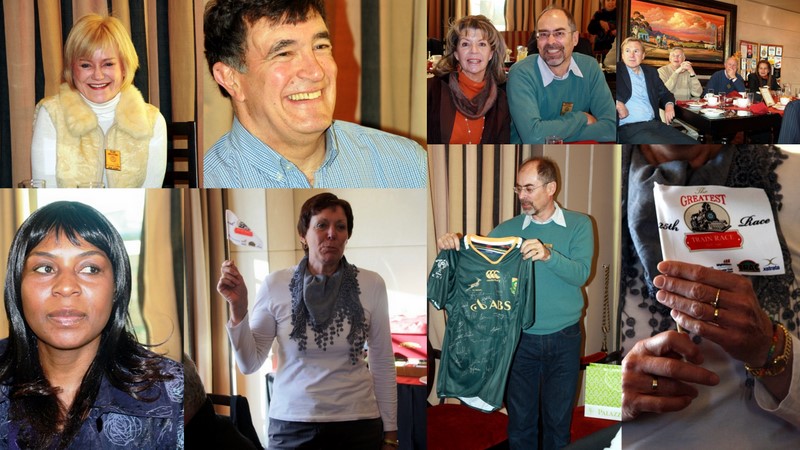
On Saturday 20 August Graham, Joan, Mike and Linda helped to marshall the
Middelburg Great Train Race pictured here with Baksteen and Solly at the race.


So many other things seem to have happened.  Graham & Joan Donet and Mike & Linda Vink helped marshall at The Greatest Train Race in Middelburg and earned the Club R5 000!


And the new Gas Stove has been installed at The Christ Church Christian Care Centre..........

Pictured from left to right around the stove – Sarah Sunker, Rev Mike Sunker and Margaret Lediga from the Centre; Jan-Kees Sligcher , President of New Dawn; Linda Vink from New Dawn and Simon Sibeko and Anesh Salikram from Momentum and Mike Vink from New Dawn.
It is only a week to our Sponsored Lecture.  See full details in the side bar....including where to park!


Polio eradication within reach, despite concerns


Mary P. Torre, 2010-11 president of the Rotary Club of Tumon Bay, Guam, Guam, immunized children in Mukand Pur, Delhi, India, during a National Immunization Day in March. Among polio-endemic countries, India has recorded the fewest cases – one – in 2011. Photo by Allison Kwesell
Among the key goals of the Global Polio Eradication Initiative(GPEI) is interrupting transmission of the wild poliovirus by the end of 2012. Although the GPEI Independent Monitoring Board (IMB) reported in July that this goal may be in jeopardy, it also noted signs of progress and provided several recommendations that could help get the program back on track. 
The GPEI has made significant steps forward since the launch last year of its new strategic plan and the bivalent oral polio vaccine. Among the four polio-endemic countries, India has reported only one case of polio so far this year. The country “is on track to interrupt transmission this year,” thereport states.   
“The northern part of India, where most of the problem had been, hasn’t had one case in 15 months,” adds Robert S. Scott, chair of Rotary’s International PolioPlus Committee.  
The other polio-endemic countries are Afghanistan, Nigeria, and Pakistan. The IMB report cites good progress in Afghanistan while spotlighting the challenge of immunizing children in conflict areas. Nigeria also has been making good headway but, following elections in April, needs to sustain the political commitment required to ensure eradication of the disease.
In Pakistan, cases doubled in the first six months of 2011, compared with the same period in 2010. The report commended the country’s high-level commitment to polio eradication through its national emergency action plan, launched in January, but added that the plan needs to make a stronger impact at the local level.  
The report also expressed concern about controlling polio in countries with reestablished transmission, including Angola, Chad, and Democratic Republic of the Congo. 
Despite these challenges, polio cases worldwide decreased almost 50 percent during the first six months of 2011, compared with the same period in 2010.  
“Type 3 polio numbers have dropped to 15 this year,” says Scott, referring to one of only two strains of the wild poliovirus that remain. “It appears type 3 will soon be eradicated completely.” 
Health experts believe that eradicating polio, rather than trying to control the disease, is both feasible and essential. 
“There are approximately a dozen countries where polio gets reported sporadically, and those cases can all be traced back to the four countries where transmission has continued,” says Robert Murphy, director of the Center for Global Health at Northwestern University in Illinois, USA. “If we focus on those four countries, the cases in the other countries are going to evaporate. 
“It’s very important to finish the job soon, because we’re so close. If we back off now, the problem is going to get bigger and even more expensive.” 
Finishing polio once and for all, the IMB report states, will require enhanced political commitment, secure funding, and strengthened technical capacity.
“The eradication of polio is the responsibility of every government,” says Scott, noting the unanimous decision in 1988 at the World Health Assembly to pursue that goal. “Rotarians in every country must continuously talk it up with their fellow Rotarians and, at every opportunity, with their political leaders, to ensure support, both financial and moral.”
During a TED conversation in July, Bruce Aylward, the World Health Organization’s assistant director-general for polio eradication and related areas, called Rotarians’ efforts at the international and grassroots levels “incredibly powerful for a global health initiative like polio eradication.” 
Everyone can help end the disease, Aylward said, by providing funding and reminding their communities and government leaders that polio still exists and causes tremendous suffering. 
“We have the chance to ensure that no child ever suffers from polio again, and each of us plays a role in that,” he said.

Saturday, 20 August 2011

Richard Cock, Handbags & the Drought in the Horn of Africa.


This week our speaker is well known musician and conductor, Richard Cock.  Richard Cock has made a significant contribution to music in South Africa since returning in 1980 from an 8-year sojourn in the United Kingdom.  

During those years he studied at the Royal School of Church Music and then gained experience in church music and education ending his days abroad as assistant organist and Director of Music at the Cathedral Choir School in Chichester.


The Conductor

Since returning to South Africa he has been an SABC producer, Director of Music at St Mary’s Cathedral, Director of Chanticleer Singers and Symphony Choir of Johannesburg, and a conductor of note.  
Having gained experience as Personnel Manager of the NSO in the eighties, Richard Cock became Artistic Director of that Orchestra from 1991 - 1999.  Previous to this he had been Director of the Transvaal Chamber Orchestra from 1987 - 1991 and this orchestra ceased to operate when he became Artistic Director in 1991.
During that time the symphony concerts grew in popularity and scope and Richard managed to take the orchestra out of the concert hall to varied venues, from Cape Town to Cairo.   They truly became the National Symphony Orchestra performing both in small towns and large cities throughout South Africa and its neighbouring territories, as well as making a memorable tour to Cairo
He continues this work throughout South Africa – in particular with the Johannesburg Festival Orchestra, and, with his irrepressible and ebullient nature, to bring music to tens of thousands of people and to make converts to the cause of orchestral and choral music in particular, and of ‘music’, in its broadest sense, in general.
Richard is equally at home making music with children in a classroom, with leading soloists of the day in the concert hall, with choirs in churches, or with the orchestra in Tulip fields, amongst others he has worked with Julian Lloyd-Webber, Lynn Harrell, Joshua Bell, Florian Uhlig, Lesley Garrett, Zoe Beyers Corinne Chapelle and Patricio Buanne.
He has also worked closely with Pavarotti and the 3 Tenors on their South African Tour.


Our speaker last week was Alta McMaster of The Jes Foord Foundation who spoke passionately about the need to assist rape victims.  This gave great encouragement to those involved in the Handbag Project.  Here she is introduced by Sue Beuthin.


We had such a good turnout that we had to squeeze in extra seating at tables!


Next week is the 5th Wednesday when we have an evening meeting.  Watch this space!


We were all relieved to see Jenine Coetzer back safe and sound from Mogadishu.  She will be talking about her experiences and showing pictures at our meeting on the 2nd Wednesday of September.  I am also delighted to have our official photographer back!  Many thanks, Jenine! 


District 9200 delivers famine relief to Kenya communities gripped by drought


Top: Geeta Manek, District 9200 governor-elect, plays with children during a visit to the village of Kaikor in the Turkana district in northern Kenya on 25 July. Photo courtesy of District 9200


Drought-stricken villages in northern Kenya received desperately needed aid this week from District 9200 (East Africa) and the Red Cross, which delivered more than 18 tons of food and water.
The hunger crisis plaguing the Turkana district in northern Kenya is a "stark example of what is happening to people in East Africa," says Geeta Manek, District 9200 governor-elect. The Horn of Africa's worst drought in 60 years has sparked famine conditions in Ethiopia, Kenya, and Somalia.
Manek, along with three Rotarians and the secretaries general of Kenya Red Cross and Canadian Red Cross, visited the village of Kaikor on 25 July.
"We witnessed horrific scenes of starvation and unimaginable poverty," says Manek, a member of the Rotary Club of Muthaiga, Kenya.
The drought in Africa has affected more than 12 million people including 3.7 million who are at risk of starvation, according to the United Nations. Tens of thousands of people have died in southern Somalia, including 29,000 children under the age of five. Hundreds of thousands are fleeing Somalia to seek aid in Ethiopia and Kenya.
While many international relief agencies are at the southern border of Kenya and Somalia, Manek says the nomadic villages of Turkana, including Kaikor, have received little aid.
"There are so many areas that have been totally forgotten, and Turkana is one of them," says Manek. "We [Rotary] must act quickly."
District Governor Eric Kimani says there is an alarming rate of malnutrition among children in Turkana.
"We are stunned by the scale of this devastation. The exodus of malnourished children to feeding centers is shocking," Kimani says. "A rapid increase in emergency aid is required to stave off catastrophic starvation."
Kimani is appealing to Rotarians worldwide to help the district secure food and water for thousands of people still at risk in Turkana.
"While the entire region [Horn of Africa] has experienced prolonged drought, the situation has been exacerbated by political instability and climate change," says Kimani. "But we as Rotarians must find ways to address the hunger crisis first."
In response to the crisis, The Rotary Foundation has established the Rotary Horn of Africa Famine and Refugee Relief Fund, which will support recovery projects in the affected areas.


Sunday, 14 August 2011

The Jess Foord Foundation, Trinity Health Services & Attracting Young People to Rotary.....you might like to comment!


Our speaker this week is Alta McMaster of the Jes Foord Foundation which will really explain what the "Handbag Project" is all about.  The video says it all.


The Foundation is collecting men’s, women’s and children’s hand bags and filling them with the items below for distribution to the survivors:
Panties
Liquid soap
Body cream
Sanitary pads
Face cloth
Lipstick
Chocolate
A small gift

The Rotary club of Johannesburg New Dawn is proud to be assisting Jessica by collecting the hand bags and contents from members and friends, and welcomes all contributions.
Once the handbags are handed over to the Police Stations, they are sealed in a plastic bag and given a number and monitored on a regular basis.


HSBC has dedicated the whole of August to Women and have selected our New
Dawn Rotary Club Handbag Project as their Staff Charity project and they will be collecting goodies for our handbags. Sue

Last week our speakers were Zeenat Bikhoo and Natalie Prinsloo of Trinity Health Services.  It was a very interesting presentation because we don't see enough of the projects that students, in this instance medical students, do in terms of outreach to the severely disadvantaged.
It is not often we have a visitor from Berlin....that's what the banner presentation is all about!


Enjoy Peter, Paul & Mary in the Video Bar!
Here's Graham Donet leaving Rotary.  He should have offered us all a ride!  Vespas don't age..........


Rotary clubs make changes to attract younger members


Members of the Diablo View Rotary Club donate their time by cleaning up the Iron Horse Trail in California. Photo courtesy Diablo View Rotary Club
When Rotarians in Walnut Creek, California, USA, found it difficult to attract young professionals to the area's morning and afternoon clubs, they set out to establish a new club that would accommodate busy, on-the-go schedules. 
The Rotary Club of Diablo View (Walnut Creek), chartered in 2009, meets in a local brewery at 5:30 p.m. every Thursday. Club president Jennifer Beeman says the club sets aside time each week for socializing before turning to club business, and that the relaxed atmosphere appeals to younger members.  
Beeman was only 24 years old when she became a charter member of the club, and she's now one of the youngest female club presidents in Rotary. The club has 26 members, 90 percent of them between the ages of 25 and 40.
"Because we have younger members, our attitude is different. People have told us how refreshing it is to have young faces behind Rotary," Beeman says.
She says the club carries out many projects in the community so that members have an opportunity to do hands-on service. Every month, for instance, it plans an outdoor project, such as cleaning up nature trails. Younger Rotarians usually have more time than cash at their disposal, she says, so they tend to contribute by volunteering.
The club recruits new members through social media like Twitter and Facebook, and it has a mentoring program to help with retention. All new members are assigned a mentor, who spends extra time with them outside regular meetings.
"The modifications we've made have helped our club appeal to younger professionals and retain them," Beeman says. "They’ve created a high-energy club."
Beeman says clubs must be willing to make a few changes to attract younger members. Here are some examples of what other clubs are doing:
  • Through a student membership initiative, the Rotary Club of Hope Island, Queensland, Australia, invites college-age students to meetings and subsidizes the cost to bring a youthful perspective to the club. 
  • The Rotary Club of Las Vegas, Nevada, USA, has created the 25 Club, a club-within-a-club. The members hold additional meetings, sponsor regular social gatherings, and carry out a number of service projects. The inductees are generally younger, and after a year, they transition into the parent Rotary club. 
  • The Rotary Club of Crawley, Western Australia, Australia, started a mentoring program that helps new members transition into the club. The club’s average age is now in the 30s.
  • The Rotary Club of Bricktown Oklahoma City, Oklahoma, USA, meets in a tavern. First-time guests are treated to two free beverages, compliments of the club. Read more.
  • The Rotary Club of South Metro Minneapolis Evenings, Minnesota, USA, meets in the evenings and lowers costs by not having meals. The third meeting of the month is a happy hour/networking event at different locations in the city. The fourth meeting is a volunteering opportunity. Read more.
August is Membership Month. Find membership resources you can use to develop and sustain membership. Sign up for The Membership Minute.

17 Comments:
At 10:49AM on 11 August 2011, Ruchir Jani wrote:I am a Charter member of Vapi Riverside, RID3060, Gujarat, India. Our club chartered in 2004 with members at an average age of 35 and since then we are inducting young members and keep our average age below 40.
At 10:21AM on 1 August 2011, Dr.Sanjiv Sharma wrote:Rotary International shall have a different fee structure for younger members- as most are in initial struggling Phase of there careers especially in Underdeveloped countries.
At 9:39AM on 1 July 2011, Alison Cooper wrote:It is important to get new younger members. Has anyone got ideas such as a fee structure for those younger people that do not have the extra imcome to pay the normal fees and costs but have the time and energy?
At 9:48AM on 18 May 2011, Jessie L. Bower wrote:I really like the ideas presented here, our club will have to adapt if it is going to attract younger members. As a brand new member, age 26, I am already seeing several reasons why my peers are unable to join Rotary. Both clubs in Fort Wayne, IN meet at noon. Out of all my friends 99% of them would be unable to make it just because of the meeting time. I hope we can make changes to accommodate busy working professionals.
At 12:13PM on 10 May 2011, Mary-Anne DiBlasio wrote:It is important to keep recruiting younger and younger members, for the simple reason, we are getting older and older! :o)
At 10:13AM on 2 May 2011, Janey Ball wrote:Wow, I really like this idea!
At 1:12PM on 26 April 2011, Carmen Villalta wrote:Our club has Maria Jose Schonenberg as a member, she is 23 years old, and last year she was the Rotarian of the year, for all the good work and activities she organized. Our club Real de Minas Tegucigalpa is very happy to have young active Rotarians as members.
At 1:36PM on 25 April 2011, Bob James Jr wrote:We started the La Jolla New Generations club in 2007. Our average age is 32 and we are happy to be starting our 5th year in Rotary! It would be great if we could continue to spread the word about younger aged Rotary clubs being viable! There are 5 that I know of in Southern California alone! Congrats Diablo View!!!
At 11:52AM on 25 April 2011, Tim Meek wrote:Is Jennifer this years youngest Female Rotarian President in the World? Awesome accomplishment regardless!!
At 9:28AM on 25 April 2011, Kari Anne wrote:Rotaract clubs are also a great way to help raise membership in a district. Sponsoring Rotaract clubs allows young adults who are not ready to join Rotary get a head start. Many Rotaractors go on to be Rotarians, so by boosting the number of Rotaract clubs in your district you can also boost Rotary membership.
At 9:26AM on 25 April 2011, Michelle Wilkinson wrote:What refreshing ideas are on this page I was talking to the president of Yarrowonga Victoria, Australia and they have 2 meetings and 2 network community projects per month. I am glad to see we are looking towards the future - thanks Michelle
At 9:25AM on 25 April 2011, John Smarge wrote:Emily: On April 5-6 an ad hoc RI "Digital Media" Committee met in Evanston for the first time to discuss Rotary's future regarding in the clouds communication. Stay tuned!!!
At 9:24AM on 25 April 2011, rotr. james abandy wrote:its nice..keep up the good work
At 9:22AM on 25 April 2011, Vishal Gupta wrote:Our Club Siliguri Green is the yougest club in RI Dist: 3240, average is around 32! Young bunch of Rotarians have a long way to go.
At 2:12PM on 22 April 2011, CHRIS TUBLER wrote:Yucca Valley Sunset, California had one of the youngest Presidents at age 22. We meet in the evenings and enjoy cocktails and fellowship that sometimes goes way beyond the meeting.
At 1:00PM on 22 April 2011, Emily Francona wrote:With the continued ageing of club memberships, club leaders simply cannot afford to ignore the powerful outreach potential of social media. Any club that does not use at least one of them (arguably FaceBook is the most popular at the moment), is not seriously dedicated to attracting and keeping newer and younger members.
At 3:15PM on 21 April 2011, Carol Dois Woodward wrote:Way to go! I love the new, hip, with it and cool ideas of the New Generations folk. Nice compliment to the experience and open mindedness of us more mature Rotarians.

Add a comment

* indicates a required field


Saturday, 6 August 2011

A Couple of our Projects and this week speakers from Trinity Health Services.

Last week was a very satisfactory Business Meeting as the year had got off to a good start with committees either having met or just about to.  You can see how serious everyone was!

Don't forget to let me know if you are prepared to go to Middelburg to help with The Greatest Train Race 19th/20th August.  So far I only know of our President going.


As far as Christ Church Christian Care Centre is concerned, this is from Linda Vink......

Mike and I handed over a huge donation from a
company called Food Creations - this is their third donation - to the 5 C's.
The donation consisted of frozen meat and vegetables, baking products and a
variety of other goodies such as ham, polony, hot dog sausages, tomato
sauce, mustard etc. We collected it yesterday and handed it over to Nancy
Mudau, their social worker. She is in the picture together with 4 little
boys from the home.


Similarly our Wheel chair Project under the guidance of Lucille Blumberg is ongoing!  Our thanks to Northcliff Rotary Club for their continuing support in supplying the chairs.

This is what Lucille has to say:


The wheel chairs were donated to members of the Hluvekani community , part

of the Bushbuckridge district which has been identified as a presidential
focal area for poverty alleviation.As one of the New Dawn Rotary
members..... I am planning on an infectious diseases project in the area
together with the Veterinary Faculty of the University of Pretoria and met
up with Mr Petrus Sibuyi, the occupational therapy technician for the area
who highlighted the desperate need for assistance for disadvantaged persons
in the community .The community is mainly agro-pastoral and accessing
clinics and paypoints for physically handicapped persons is very
difficult......... am sure you can add something one of the recipients
alreay phoned and said life is so much easier - can access the clinic, pay
points for grants etc etc.
I want to get more for this community. Petrus is so excited. .....
This collage shows what the provision of a wheel chair means to someone in Hluvekani.


Items like this that pertain to specific projects are also copied onto the page for that particular project.

This Week
Our speakers are Dr Zeenat Bikhoo & Natalie Prinsloo of Trinity Health Services.  Lucille has managed to find copies of the books that have to be kept by a pharmacy in terms of the law (R10 000's worth) so that they will now be able to open a proper pharmacy at Trinity Health Services.

Trinity Clinic – Trinity Health Services

During 2004, Holy Trinity, in conjunction with medical students at the University of the Witwatersrand, set up the Trinity Health Services Clinic to provide medical service to the many street people who come to Holy Trinity on a Monday evening. It has long been the task of the Braamfontein St Vincent de Paul conference (SVP) to provide supper for the local street people every Monday night. Students have always been a part of this enterprise: helping to make and distribute food, and washing up afterwards. But, in 2004, Bronwyn Weber, then a fourth year medical student, was instrumental in getting a Clinic off the ground, bringing in the help of her fellow students and, when necessary, that of a doctor.
This Clinic has arisen out of a definite need for medical attention for those with life threatening diseases, especially HIV/Aids. Although the students may not prescribe medicines, they are able to give to the people living on the streets a service to which they would not normally have access. However these things always work both ways, for the students gain valuable experience in the process.
In 2009/10 major alternation were made to the area under the Church so that the growing clinic would have the facilities they need – consulting rooms and a pharmacy.  This was made possible by many generous donations and the hard work of the medical students.
The SVP and the students could also do with your hands on Monday evenings so feel free and most welcome to join us at the parish at 18h00 every Monday evening to feed the five thousand – every Monday of the year.

Rotary Humanitarian Centre
Linda Vink & Paul Kasango were on duty last Saturday morning.  (Even before the Club was chartered we have opened the Humanitarian Centre on the First Saturday morning of the month)
This just shows how worthwhile Saturday mornings are!


Resourceful fundraisers fuel Rotary's US$200 Million Challenge


Past District Governor Jeff Coup and Eric McDowell, both members of the Rotary Club of Milton, Pennsylvania, USA, join Rotary Pedals Out Polio riders at a stop in Milton to receive a contribution for the polio eradication campaign. Photo courtesy of the Rotary Club of Milton
Rotarians have raised US$185 million for Rotary's US$200 Million Challenge to help underwrite the cost of ending polio around the world. Although the challenge runs through 30 June, it is vital that fundraising efforts continue until the disease is finished. 
Many clubs are enlisting the support of their communities. Rotarians in Australia and New Zealand, in cooperation with 20th Century Fox, held a benefit screening of the movieConviction at 36 theaters in February, netting $54,000 for Rotary’s challenge. A fashion show sponsored by the Rotary Club of Fremont Warm Springs Sunrise, California, USA, garnered more than $52,000 in March. And in a weeklong project organized by the Rotary Club of Pondicherry-Cosmos, Pondicherry, India, 3,000 students at Petit Seminaire Higher Secondary School raised $25,000. 

Walking in Tanzania to end polio 

More than 320 Rotarians and friends of Rotary walked through Moshi, Kilimanjaro, Tanzania, in June, raising about $38,000 and boosting awareness of the disease. A marching band, polio surviors, and Rotarians wearing red End Polio Now T-shirts led the walk, organized by the Rotary Club of Moshi and several others. 
Reginald Mengi, founder and executive chair of IPP Group, one of the largest conglomerates in East Africa, called on businesses to help eradicate polio. Leading by example, Mengi contributed $32,000 to the event. 
"This is called corporate social responsibility," he said. "You must give back to the community."  
Both Mengi and Stephen Mwanje, 2010-11 governor of District 9200, encouraged parents to have their children immunized against polio. 
"We must be aware and take all measures, since the disease can spread here within a short period of time," Mwanje said. 

Rotarians ride in Pennsylvania

District 7370 (Pennsylvania, USA) sponsored a four-day, 330-mile bicycle tour of all 34 of its communities. Rotarians and friends donated at least $25 each to ride in the June event, called Rotary Pedals Out Polio.  
"Most people made donations online, as 'virtual' riders," said Past District Governor Jeff Coup, who came up with the idea for the tour and has served as the district's PolioPlus subcommittee chair since the program began in 1985. "We also had radio and a lot of newspaper coverage all through the district. Some clubs arranged for police escorts for us as we entered or left town. One arranged a PolioPlus billboard on our route."  
The fundraiser netted more than $21,000 for Rotary's challenge. Key to its success, said Coup, was "a great district committee that did the publicity, did a website with all the information, processed all the donations," and handled other tasks. "The event really reawakened awareness of the polio eradication cause in our district among Rotarians and the general public." 

Plan for World Polio Day

 
It’s not too early to plan for World Polio Day, 24 October, an excellent opportunity for your club and district to support the global effort to eradicate the disease.